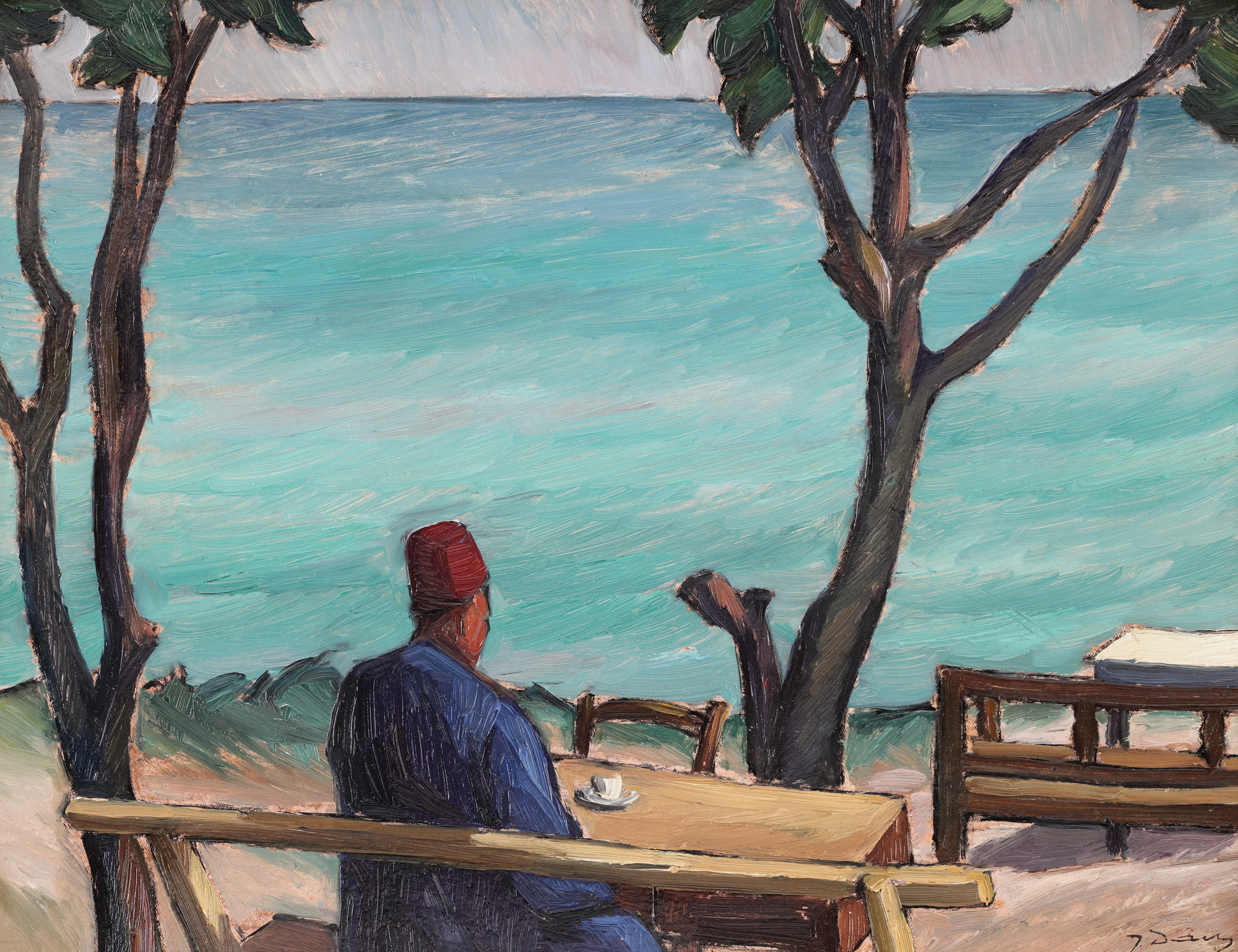
28. Turk at the Cafe (Balcic) [1929]
-
Dan Ialomiţeanu
lot.estimate:
800,00 EUR
- 1.200,00 EUR
lot.sold:
900,00 EUR
- signature
- signed, dated and located lower right, in black, "I. Dan., Balchik, (1)929"
- medium
- oil on cardboard
- description
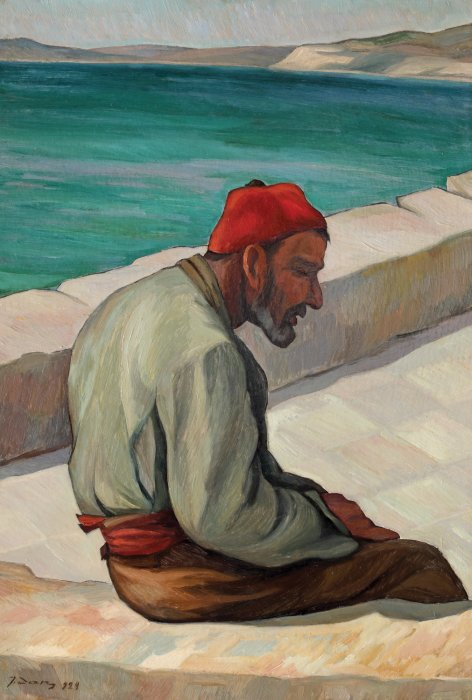
- Among the landscape and flower paintings that consecrated him in the artistic life of Bucharest between the two world wars, Dan Ialomițeanu will intersperse, initially shyly, and then with religiosity, some portraits. The vibrant color scheme, with shades of bright red, variations of green or blue, ocher variations and earthy tones, or the short brushstrokes, applied alert and repeatedly, ultimately describe a composition dominated by clarity. Like other artists of the past century, Dan Ialomițeanu will embark on the initiatory journey to Balchik, a journey that contributes to the artist's evolution from the status of neophyte to that of master adept at his technique and predilections. Thus, the end of the 1920s will represent an important moment in the evolution of the Romanian artist arrived in the arid lands on the coast. With a clear inclination towards landscape, Dan Ialomițeanu will not, however, ignore the man. Portraiture becomes a preferred direction from this moment on, and characters such as old Osman or Ahmet Ali will complete the results of his journeys to Balchik. The silent, pensive Turk, the barefoot children or the Tatar women who work in yards or houses will become the painter's favorite subjects. Caught this time with his back turned, the protagonist of this work becomes the representative of an entire social category, occupying the foreground of the canvas and hinting at his native place, with the calm sea and the rocks frozen in time. Constructed harmoniously, the work receives perfectly balanced compositional plans, carefully chosen volumes, superimposed by rhythms and carefully studied nuances.
- bio
- BARBOSA, Octavian, "Dictionary of Contemporary Romanian Artists", Meridiane Publishing, Bucharest, 1976.
- dimensions
-
- width: 40.5 cm
- height: 32.5 cm
- dating
- 1929