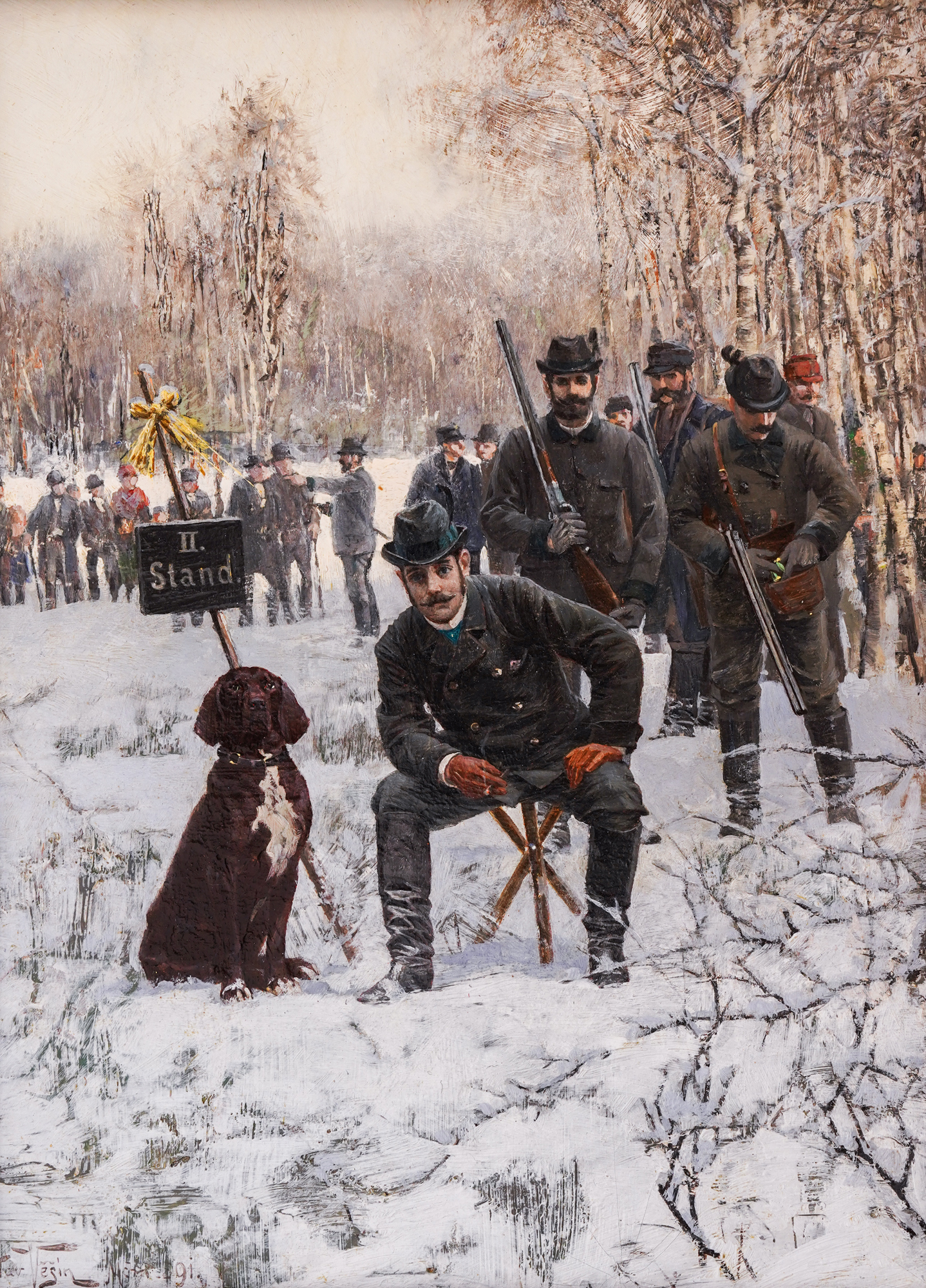
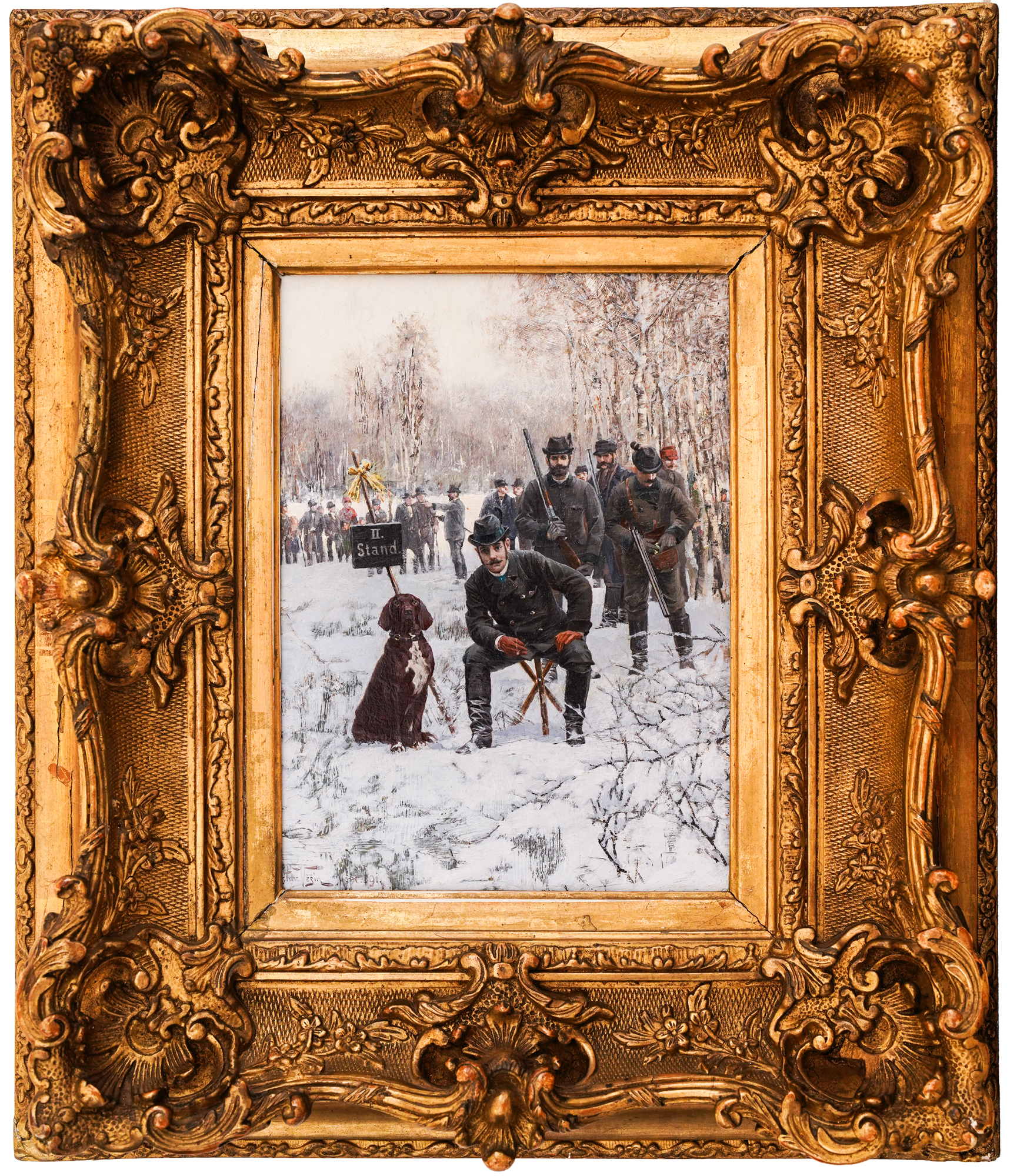
48. Archduke Franz Ferdinand on the hunt [1891]
-
lambidis-silverware lambidis-silverware
lot.sold:
15.000,00 EUR
lot.estimate:
5.000,00 EUR -
8.000,00 EUR
lot.sold:
15.000,00 EUR
- signature
- signed, dated and located bottom left, in brown, "Jaroslav Věšín Munchen, 1891"
- medium
- oil on fiberboard
- description
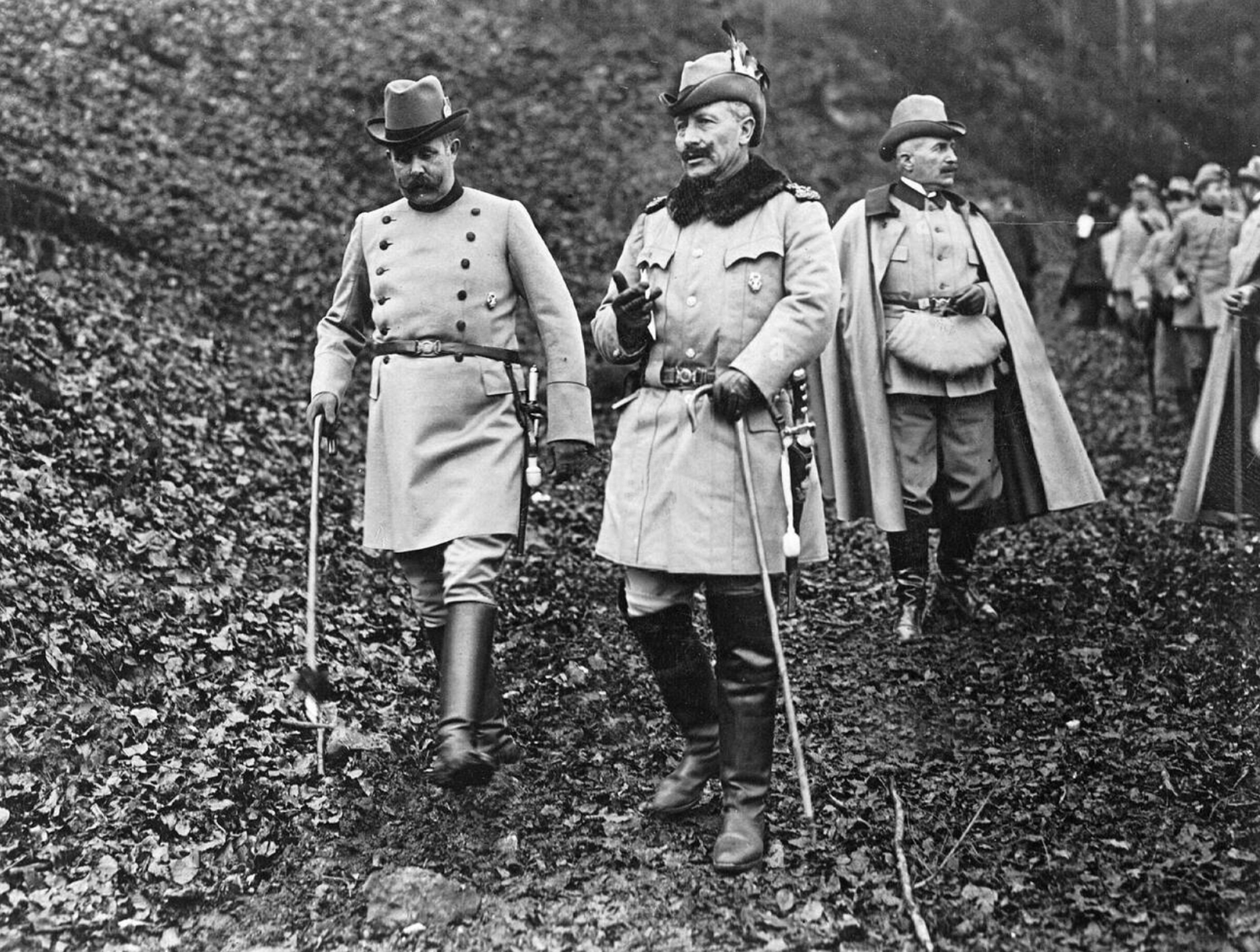
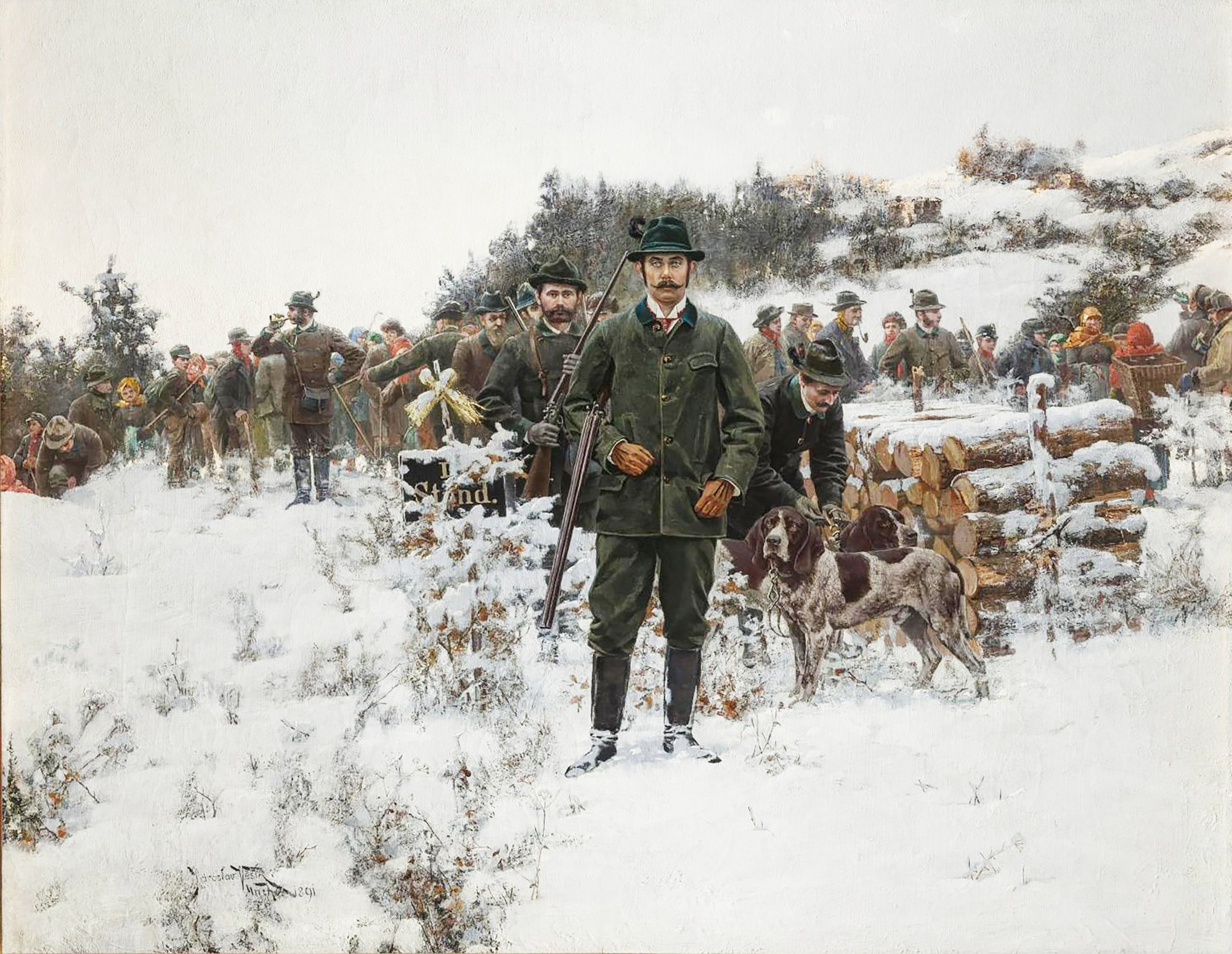
- Archduke Franz Ferdinand was born in 1863 in Graz, in the Austro-Hungarian Empire, and was the nephew of Emperor Franz Joseph I and his chosen heir. He was the firstborn son of Archduke Karl Ludwig (the younger brother of Emperor Franz Joseph I) and Princess Maria Theresa of Bourbon-Two Sicilies. As the emperor’s nephew, he grew up at the center of the imperial court, though he was not initially first in line to inherit. After the suicide of his first cousin, Crown Prince Rudolf of Austria, in 1889, Franz Ferdinand became the second most important figure in the dynasty. Since Rudolf had no children, the next in line for the throne was Franz Ferdinand’s father, Karl Ludwig. Following his father’s death in 1896, Archduke Franz Ferdinand became the direct heir to the imperial throne held by his uncle, Franz Joseph. Until that point, Franz Ferdinand’s life unfolded in the courtly environment, with a strong focus on education and the Catholic faith. His life leaned more toward military service, travel, and personal interests than toward political power. Hunting was one of his greatest passions, both in his youth and throughout his life. Between 1892 and 1893, Ferdinand embarked on a world tour, visiting India and Australia, where his hunting trophies included exotic local fauna. His passion for hunting was excessive even by the standards of the European aristocracy of his time. In his diaries, he recorded having killed 272,511 animals, including 5,000 deer. Around 100,000 of his trophies were displayed in his castle at Konopiště in Bohemia. In the oil painting on wood Archduke Franz Ferdinand at the Hunt (1891), Czech painter Jaroslav Věšín captured the young heir to the throne engaged in his favorite pastime. In this remarkable hunting portrait, Věšín depicted the archduke at just 28 years of age. Seated and smoking a cigarette, Ferdinand occupies the foreground of a deeply snow-covered composition. At his side sits his loyal hunting hound. In the background, the rest of the courtly hunting party can be seen waiting patiently for the heir to finish his break, preparing his rifles for the next shots. The wintry chill is palpable in the thick snow covering the ground, the snow-laden branches, and the heavy winter clothes of the figures in the painting. By this point in his artistic career, Věšín had already established himself as a true master of winter landscapes and hunting scenes. Much of the 1880s he spent in Slovakia, focusing on local genre painting, with many works depicting heavily snow-covered landscapes, hunting subjects, and the interaction between people and their natural environment. All of these elements are present in the 1891 painting, though here the central figure is not Slovak peasants but the heir to the Austro-Hungarian throne and his courtiers. The work is, in fact, a smaller version of a larger canvas (70 x 90 cm) from the same year, with a very similar subject. In that version, Ferdinand is shown standing with a rifle in his hand, hunting dogs poised at his left, and many more figures in the background. Nevertheless, the two courtiers directly behind the archduke appear identical in both paintings. It was with this painting that Věšín took part in the Prague annual exhibition of The Beautiful Unity — the most important art association of the 19th century active in the Czech lands. Emperor Franz Joseph I and Archduke Franz Ferdinand were the most significant patrons of the association and its exhibitions, which helps explain why Věšín chose the imperial heir as the central subject of some of his works in 1891. The following year, the Czech painter donated the oil painting to the Picture Gallery of the Society of Patriotic Friends, today the National Gallery in Prague, where the work remains to this day. Thus, in this intimate, chamber-like work, several crucial threads of European history and art are interwoven: the hobbies and interests of high-ranking figures of the empire, the exhibition trends and structures of aristocratic Czech associations, and the artistic development of one of the most important painters of both Czechia and Bulgaria. (M.Z.)
- dimensions
-
- width: 17 cm
- height: 23 cm
- dating
- 1891
INFORMAȚII SUPLIMENTARE
Fotografiile lotului sunt informative și orientative, neputând să asigure o vedere extrem de detaliată a obiectului din toate unghiurile. Recomandăm inspectarea fizică atentă a lotului înainte de licitare. Informații suplimentare în legătură cu starea de conservare, altele decât cele evident vizibile în fotografia/fotografiile lotului, disponibile pe calea formulării unei solicitări aici.
Pentru neclarități în legătură cu procedura de licitare, costurile adjudecării, termenii de garantare, de plată și de ridicare a lotului adjudecat recomandăm citirea/recitirea cu atenție a Regulamentului de Licitare.
Pentru informații suplimentare în legătură cu lotul și licitația contactați Departamentul de Consultanți de Artă.