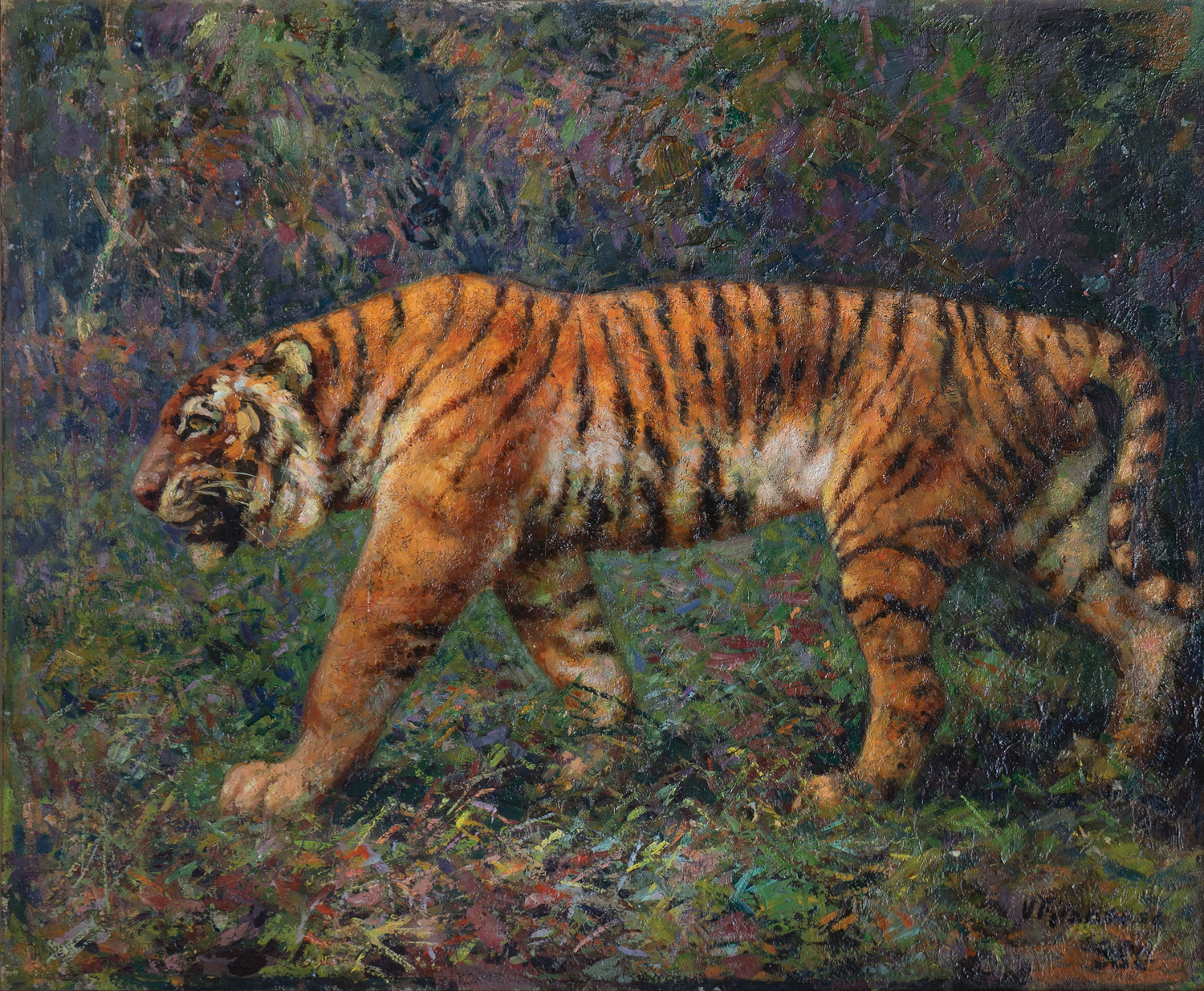
72. Tiger Hunting [1956.]
-
octavian-olariu octavian-olariu
lot.estimate:
6.000,00 EUR
lot.estimate:
6.000,00 EUR -
9.000,00 EUR
lot.not_sold:
- signature
- signed and dated lower right, in black, "V Filakovac (1)956"
- medium
- ulje na platnu
- description
- The most vital colorisms and drawing virtuosities of Filakovac occur on beasts and birds. In the history of Croatian painting of the 20th century, rare examples of beautifully painted animals are found, and even fewer are animalists. Mašić's poultry, Medović's quails, Kraljević's ducks and horses from the early last century, Tiljkovi's oxen, Becić's cats and skinless lambs, and Ružić's birds, and finally Džamonja's deer – are first-rate art but also regarded as one-off instances in these creators. Thus, when speaking of animalism and its founder in modern Croatian art, Filakovac and his entire opus must be emphasized. Matko Peić, the curator of Filakovac's exhibition in his native Slavonski Brod, where the painting "Tigar"(Tiger) was also displayed, described his painting personality as follows: Due to the works of great Flemish and French animal painters he saw in old Budapest Gallery, thanks to Budapest Zoo but mostly due to his original character – Filakovac became a Croatian painter asserting he has painted the most significant amount of beautiful wild and forest animals of local and foreign origin. Vladimir Filakovac studied painting at Budapest's Academy and spent his summers in Vukovar painting his favourite Slavonian landscapes and animal motifs for which he, as a passionate hunter, had a lasting inclination and a continuous influx of "models". His first exhibition at a Budapest art salon in 1913 was a significant success. He achieved similar success the same year at the Zagreb Ullrich Salon. During the Great War, graduated as an academic painter, he returned to Osijek, from where he was immediately sent to the battlefield. The period from 1921 to 1923 was spent in Vienna where he did graphic work and illustrations for magazines and the few oils he painted those years were portraits and studio studies of acts. Since his return to his homeland, he often "worked" during summers in Hvar resulting in a beautiful cycle of oil landscapes and cityscapes. In 1930, at the invitation of writer Branislav Nušić, who was his friend through "hunting line", he left Osijek and moved to Belgrade, where he worked as an illustrator. His first Belgrade exhibition was in 1938 at Paviliion Cvijeta Zuzorić. That same year in Zagreb, he participated in the exhibition Half A Century of Croatian Art and solo in 1939. During the pre-war 1940, together with painter Petar Dobrović, he worked on establishing the Art Academy in Belgrade where, in line with his favourite theme, he opened a department for animalistic painting. With the outbreak of war, he was forced to leave Belgrade and in early 1941 he settled in Zagreb. Since 1948, he was a full professor at the Zagreb Academy and until his retirement (1962) he taught students "plastic anatomy of animals". In the early 50s, he bought a house in Dubrava which with its lovely garden became equally valuable as a painting motif to Filakovac as wild animals. BRP
- bio
- Matko Peić, Vladimir Filakovac / On the occasion of the solemn unveiling of the monument to Vladimir Filakovac (catalogue), Museum of Brod Posavina, Slavonski Brod, pp. 5-6 and pp. 13
- dimensions
-
- width: 96 cm
- height: 80.5 cm
- research_info
- The work was exhibited at the retrospective exhibition "Vladimir Filakovac" in the Vladimir Filakovac gallery from December 15, 2003, to January 15, 2004. The work was exhibited at the retrospective exhibition "Animalism in the Work of Vladimir Filakovac" at the Croatian Natural History Museum in Zagreb, from July 18 to December 31, 2011, and was reproduced under catalog number 7, titled "Walking Tiger II".
- dating
- 1956.
INFORMAȚII SUPLIMENTARE
Fotografiile lotului sunt informative și orientative, neputând să asigure o vedere extrem de detaliată a obiectului din toate unghiurile. Recomandăm inspectarea fizică atentă a lotului înainte de licitare. Informații suplimentare în legătură cu starea de conservare, altele decât cele evident vizibile în fotografia/fotografiile lotului, disponibile pe calea formulării unei solicitări aici.
Pentru neclarități în legătură cu procedura de licitare, costurile adjudecării, termenii de garantare, de plată și de ridicare a lotului adjudecat recomandăm citirea/recitirea cu atenție a Regulamentului de Licitare.
Pentru informații suplimentare în legătură cu lotul și licitația contactați Departamentul de Consultanți de Artă.