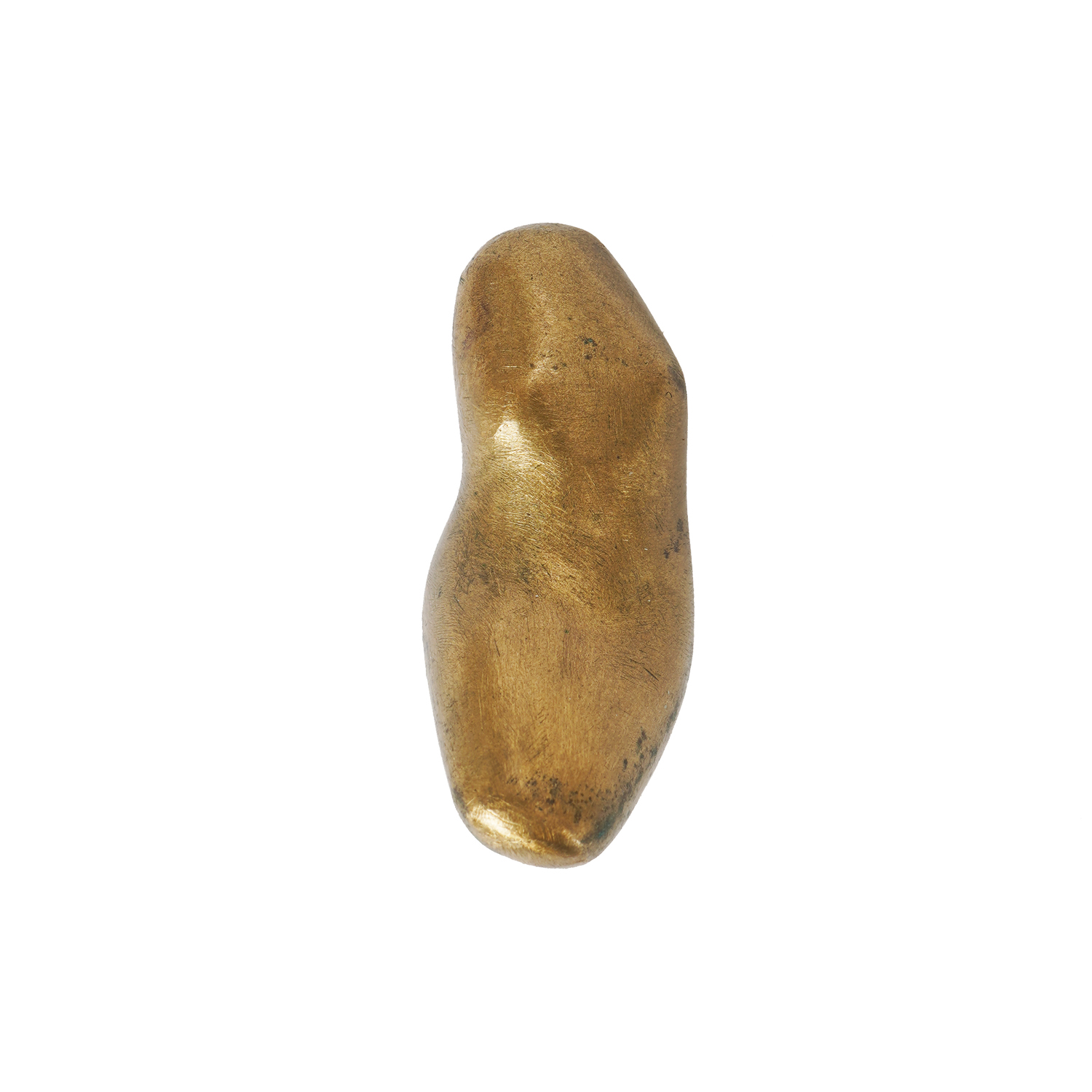
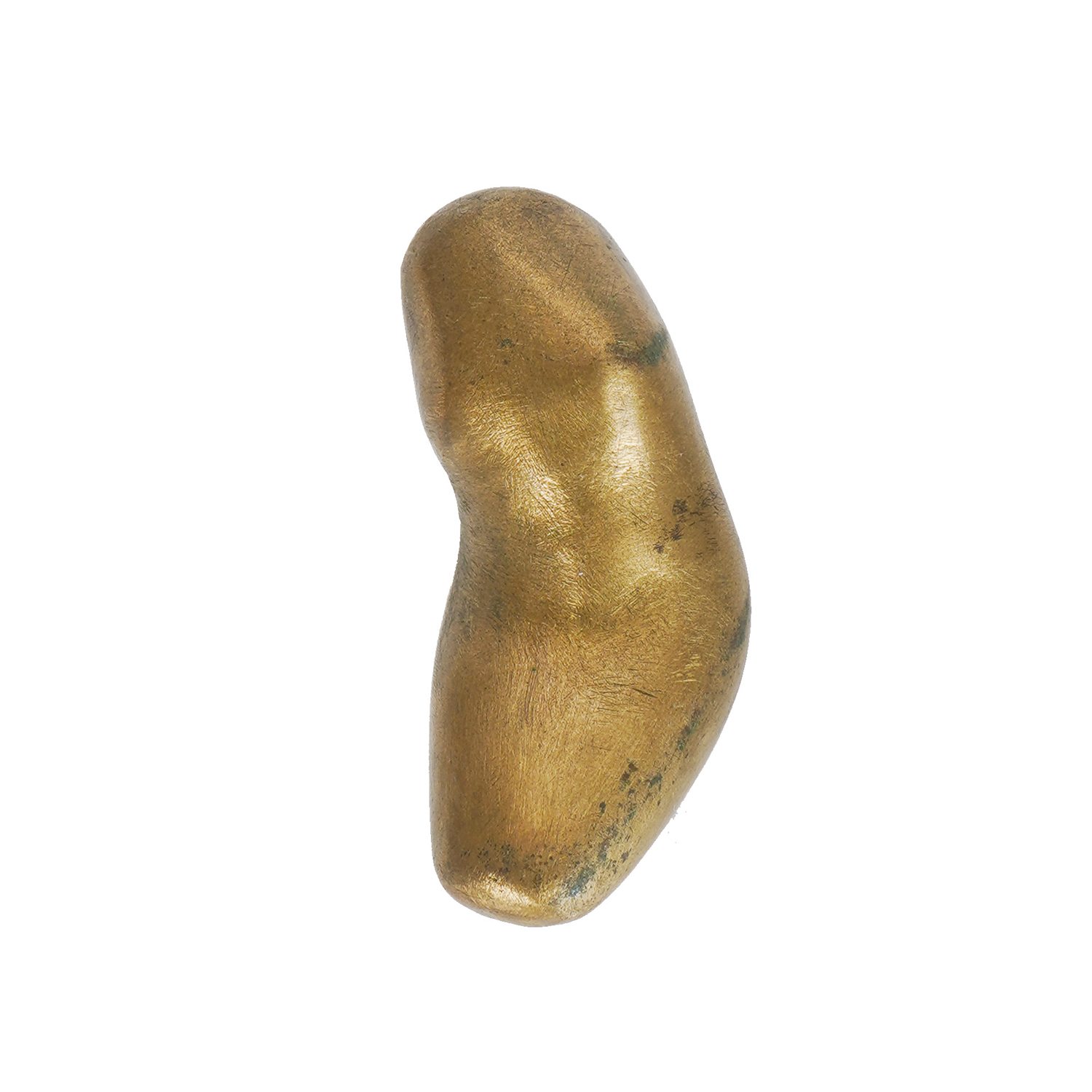
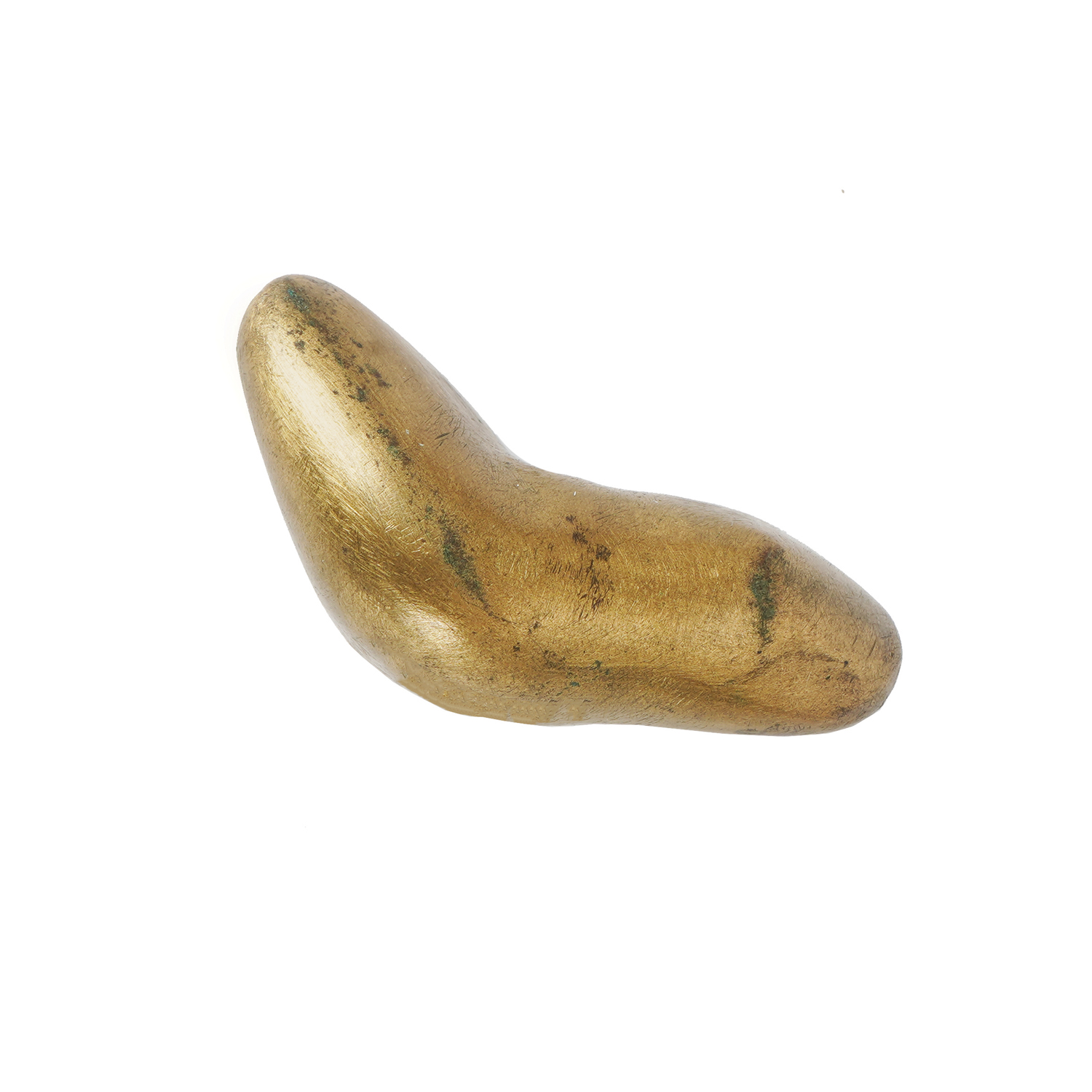
1. Reclining Torso
-
octavian-olariu octavian-olariu
lot.sold:
350,00 EUR
lot.estimate:
400,00 EUR -
700,00 EUR
lot.sold:
350,00 EUR
- medium
- bronze
- description
- The Croatian sculptor of Serbian descent, Vojin Bakić (1915-1992), played one of the leading roles in Yugoslav sculpture. Born in Bjelovar, he graduated in sculpture from the Academy of Fine Arts in Zagreb, and his distinctive artistic expression evolved over time from figurative realism to abstraction. A leader and innovator, he worked primarily in marble and bronze, and is remembered for numerous public sculptures. He is best known to the general public for his sculpture "Leafy Form", one of the most recognizable public sculptures in the city of Zagreb, and as the creator of the widely appreciated animal motif "Bull". Nonetheless, Vojin Bakić's work transcended Croatian borders and was recognized worldwide by experts. Croatian art historians such as Vera Horvat-Pintari, Milan Prelog, as well as critics such as Lionello Venturi, Herbert Read, Udo Kultermann, and Carole Giedion-Welcker, have written about him. Bakić's body of work can be subdivided into several creative periods. The earliest was characterized by the academic figurative realism of his mentors Frane Kršinić, Robert Frangeš-Mihanović, and Ivan Meštrović. During the era of social realism, he created public monuments like "Call to the Uprising" (1946-1947), also known as "The Bjelovarac", in which he embodied the image of his tragically murdered brother Slobodan, who, along with three other of Bakić's brothers, perished in the Jadovno concentration camp. During the 1950s, he distanced himself from social realism, turning to abstraction. Even though he revisited his pre-war motifs – portrait, nude, animalism – Bakić was exploring and finding new formal solutions for them. After a devastating fire in his studio in 1956, in which he lost hundreds of sculptures, studies, and preparatory sketches he had been preparing for the Venice Biennale, Bakić, in an impressively short period of few months, created new works – among them he created the famous plaster ''Bull''. Despite this period of significant losses, it marked Bakić's discovery of his own sculptural language – pure, minimalist, yet highly evocative. His work was recognized at the Venice Biennale and on numerous international exhibitions that followed. After mastering both stone and cast bronze as materials, Bakić devoted himself to the cycle of "Light Forms", creating highly reflective compositions consisting of interconnected metal circles or disks. His style came close to the principles of new sculptors united in the "New Tendencies" movement, exhibiting with them at the "New Tendencies 2" exhibition in Zagreb. Apart from sculpture, Vojin Bakić also made a significant contribution as the author of numerous Yugoslav public monuments, such as the "Dotrščina Memorial Park" (1965.), "Monument to the Victory of the People of Slavonia" (1968.), and "Monument to the Uprising of the People of Banija and Kordun" (1982.). By modernizing the concept of social realist monuments, he transformed them into architectural features and clean forms –- essentially universal reminders of the victory of the human spirit, free of political connotations. From a private collection in Zagreb comes a series of Bakić's works, which testify to the richness of the creative output of this outstanding artist and his skillful mastery of various sculptural techniques and materials – from stone and plaster to bronze and copper sheet. The collection includes two plaster models of Bakić’s ''Bull'', possibly the artist’s most recognizable motif. Both models are characterized by pure and taut forms, which Bakić brought to perfection in the 1950s. Despite its reduction to a minimum of form, Bakić's ''Bull'' retains a measure of figurality, successfully reflecting the 'tensed' character of the animal within the highly stylized sculptural achievement. Figurative elements are also visible in his female torsos, executed in bronze, stone, and plaster. With their closed and elongated forms, these torsos represent the culmination of Bakić's assault on and abstraction of the female form. Bakić's exceptional ability was to preserve the voluptuousness of the female body within simple volumes of different materials, indicating it only by slightly convex forms. The miniature "Study for a Lying Torso" provides an almost documentary insight into the initial stages of Bakić's sculptural process. The sculptor seeks the basis for the shape of the torso in the original form of the stone, following the natural shape and curvature of the pebble by chiseling. The resulting forms may have served Bakić as templates for bronze casts, as we can see in the formally related "Lying Torso", also cast in bronze. Bakić's creative processes can also be traced in his ''Study for a Monument'', which probably served as one of the miniature models for Bakić's large-scale public monuments and sculptures from the 1970s. Indeed, similar sculptural solutions can be found in works like the now destroyed "Circulation in Space" (1970), where metal bands form closed circles, creating complex shapes that intertwine with the space in which they exist. From the same collection also come metal disks, which are obviously fragments of Bakić's installations from the "Light Forms" cycle. Bakić modulated simple shapes from metal sheets cut into circles into 'light discs', which reflected light and their surroundings due to their concave-convex forms. These discs interacted as much with their environment as with the viewer himself. Apart from these fragments, we also find excellent examples of the applied art of Vojin Bakić, presented in the form of medals, badges, and models for plaques dedicated to the poet and essayist Ivan Goran Kovačić (1913-1943). This poet was an inspiration for many of Bakić's works –- from medals and plaques to busts and public monuments –- in which he sought to immortalize the likeness, work, and tragic suffering of this relevant poet and symbol of the Chetnik persecutions in the 1940s.
- dimensions
-
- depth: 2.5 cm
- width: 5 cm
- height: 3.5 cm
- research_info
- Dušan Matić (born 1926) distinguished himself in cultural circles as one of the founders of the poetry event "Goran's Spring", and made a special contribution in preserving and promoting the legacy and artistic heritage of Vojin Bakić. As his friend, and later, a member of the editorial board for the monograph of Vojin Bakić, he participated in writing, editing and publishing the monograph "Vojin Bakić, modern artist, primordial sculptor", published in 2000. As an occasional correspondent, he also worked for "Novi List", "Novosti", "Identitet" and "Hrvatska ljevica".
- provenance
- Historical Collection of Dušan Matić, Zagreb.
INFORMAȚII SUPLIMENTARE
Fotografiile lotului sunt informative și orientative, neputând să asigure o vedere extrem de detaliată a obiectului din toate unghiurile. Recomandăm inspectarea fizică atentă a lotului înainte de licitare. Informații suplimentare în legătură cu starea de conservare, altele decât cele evident vizibile în fotografia/fotografiile lotului, disponibile pe calea formulării unei solicitări aici.
Pentru neclarități în legătură cu procedura de licitare, costurile adjudecării, termenii de garantare, de plată și de ridicare a lotului adjudecat recomandăm citirea/recitirea cu atenție a Regulamentului de Licitare.
Pentru informații suplimentare în legătură cu lotul și licitația contactați Departamentul de Consultanți de Artă.