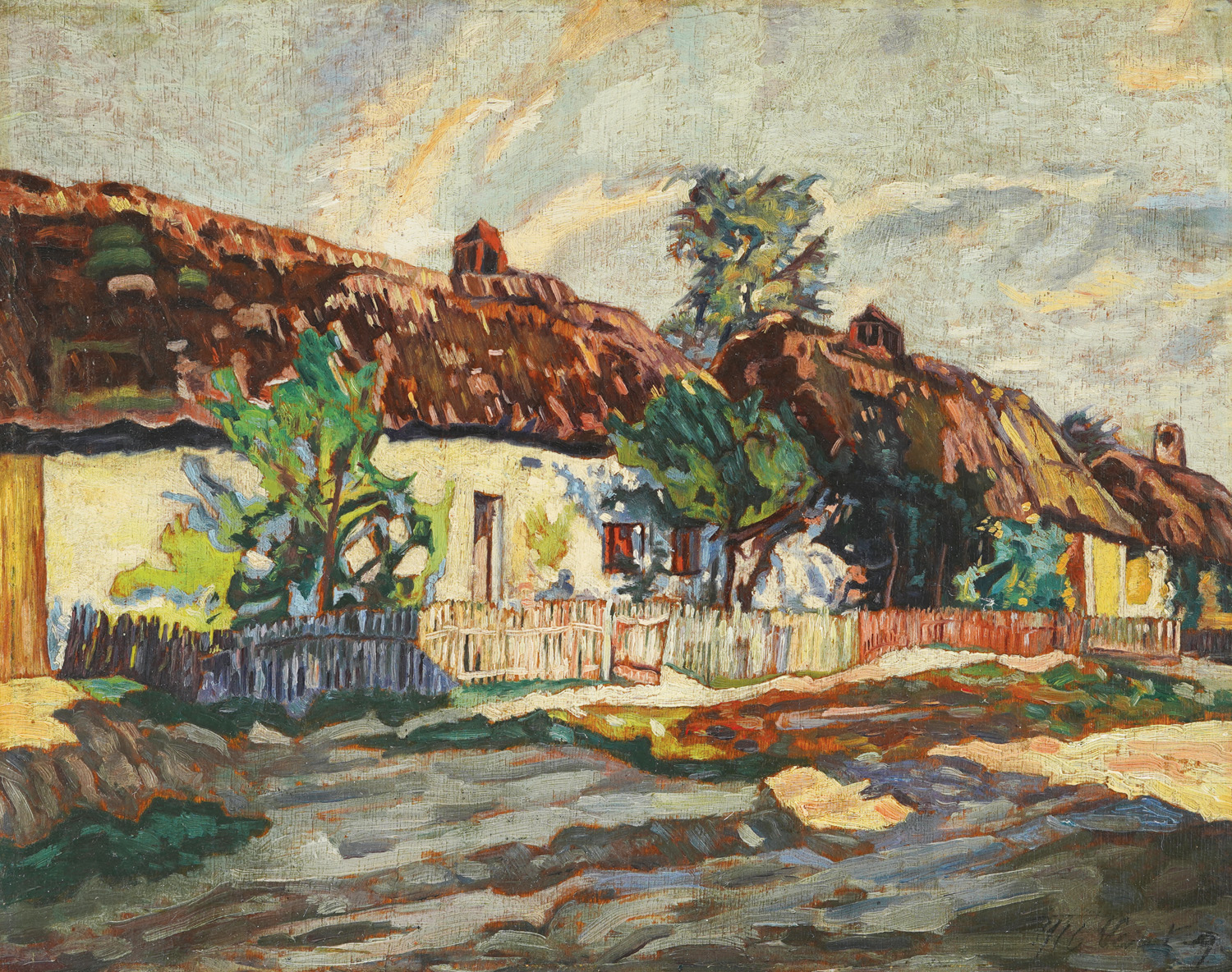
27. Village Street [1916.]
-
octavian-olariu octavian-olariu
lot.lot-withdrawn:
- signature
- signed and dated bottom right, in black, "(1)916 Vanka"
- medium
- oil on bakelite plate
- description
- The painting of a village near Marija Bistrica is an early work dedicated to the Zagorje landscape. It is special because it was painted with oil paints unlike many other early and later landscapes from the 1920s done in pastel and watercolor. It is also unique because it shows Vanka's reliance on the principles of the "colorful painting school of Zagreb", which was instilled in him by Bela Čikoš Sesija, whose class he attended at the Temporary Higher School for Art, but also because it shows a lack of stylization and more gestural brush strokes and a more liberal understanding of blotches and colors than Zagreb's Art Nouveau and Prof. Čikeš prescribed at that time. This step towards greater autonomy of landscape painting was preceded by three years of improvement at the Royal Academy of Fine Arts in Brussels (1911 - 1914), during which he had seen many museum layouts and contemporary visual achievements in that very lively artistic environment, and finally became a participant in the Brussels Triennial Salon with his painting "Pilgrimage" for which he was awarded the King Albert's gold medal. Upon returning to Zagreb as a laureate of the Brussels Salon, he immediately had the opportunity to exhibit alone at the Ullrich Salon in the fall of 1915. It should be emphasized that from 1915 until the beginning of the 1930s, Vanka gained great popularity in Croatia and won the favor of critics with his fashionable portraits, tonally harmonious figural compositions, and finally with the color of Korčula landscapes, and his work was valued both materially and socially. However, since his move to New York in 1936, the connection between the painter and the Croatian visual public and critics gradually faded and completely disappeared after World War II from the Croatian side, which was not the case with Vanka. Even in his "American" paintings, he maintained a thematic-problematic connection "with the old country". The silence of Vanka in Croatia lasted until 1968 and the donation of the painter's family to the city of Korcula and JAZU, which includes numerous American paintings and a smaller number of Croatian ones, as well as a villa in Korcula, where the Vanka Memorial Collection is located today. After the opening of the Collection, critical reviews occasionally appeared, culminating in 2002 after the retrospective held at Klovićevi dvori Gallery. It should also be said that critics were not unanimous in evaluating the presented Vanka's opus. Some reproached the painter for too much morphological diversity and heterogeneity of preoccupations, others exaggerated figural compositions of ethnic charge such as the painting "Bistrički Pilgrims" from 1915 (NMMU, MG-2156) or studies for a fresco made in 1941 in the sanctuary of St. Nicholas Church in Millvale near Pittsburgh, which are kept by the local church and the James Michener Art Museum in Doylestown (Bucks County, Pennsylvania). However, in one thing they were unanimous; all recognized Vanka's undeniable painting skills and his unique penetration into expressive expression in early paintings of Zagorje landscapes. Grgo Gamulin himself, the author of the only synthesis of Croatian visual art of the 19th and 20th centuries, writing about Vanka's early approach to modern color, highlighted these landscapes as "beautiful examples of the original moment of Croatian landscape art". (B.R.P.)
- bio
- Vladimir Lunaček, Intimate exhibition: Maksimilijan Vanka, Salon Ullrich, XI. 1915. Grgo Gamulin, Croatian painting of the 20th century, Forward, Zagreb, 1987., pp. 179-189 Nevenka Posavec Komarica, Maksimilijan Vanka - retrospective exhibition (catalogue), Klovićevi dvori Gallery, Zagreb, 2002.
- dimensions
-
- width: 38 cm
- height: 29.5 cm
- notes
- signed and titled on the back "Maximilijan Vanka, Villagers"
- dating
- 1916.
INFORMAȚII SUPLIMENTARE
Fotografiile lotului sunt informative și orientative, neputând să asigure o vedere extrem de detaliată a obiectului din toate unghiurile. Recomandăm inspectarea fizică atentă a lotului înainte de licitare. Informații suplimentare în legătură cu starea de conservare, altele decât cele evident vizibile în fotografia/fotografiile lotului, disponibile pe calea formulării unei solicitări aici.
Pentru neclarități în legătură cu procedura de licitare, costurile adjudecării, termenii de garantare, de plată și de ridicare a lotului adjudecat recomandăm citirea/recitirea cu atenție a Regulamentului de Licitare.
Pentru informații suplimentare în legătură cu lotul și licitația contactați Departamentul de Consultanți de Artă.