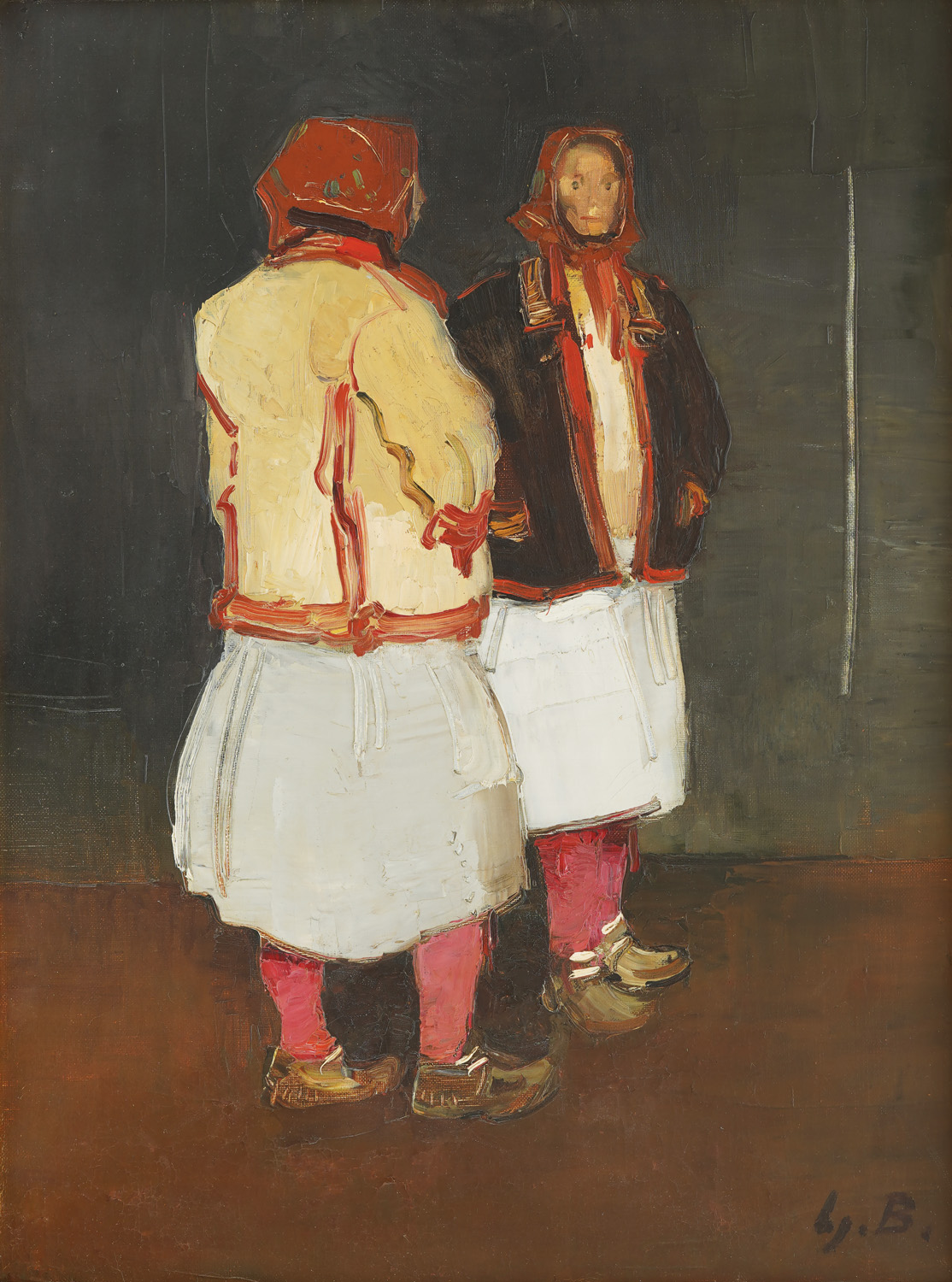
24. Two Peasant Women [1938.-1942.]
-
octavian-olariu octavian-olariu
lot.estimate:
10.000,00 EUR
lot.estimate:
10.000,00 EUR -
15.000,00 EUR
lot.not_sold:
- signature
- signed bottom right, in brown, "Lj. B."
- medium
- oil on canvas
- description
- Ljubo Babić (Jastrebarsko, 1890 - Zagreb, 1974) was a Croatian painter, writer, art historian and scenographer. Encouraged by his father, he enrolled at the Law Faculty, from which he quickly dropped out. His uncle Ksaver Šandor Gjalski steered him towards art, which Babić recognized as his vocation. With a scholarship from Count Pejačević, he studied painting in Munich and Paris. He worked as a professor at the Art School in Zagreb (today's ALU) and graduated in art history. He was friends with Miroslav Krleža, despite their opposing political affiliations, and closely collaborated with Branko Gavella. He was a prominent figure in the Croatian art scene and one of the founders, among other things, of the Croatian Spring Salon, Group of Four, Group of Three. He designed banknotes and the flag of the Independent State of Croatia. As the first curator of the Modern Gallery in 1919, he is the author of the first layout. Babić's versatility is visible in his work - from oil on canvas, pastels, watercolors, poster design and book equipment, to scenography and book writing. He begins to create in the era of Croatian modernism and the influences of his teachers Crnčić and Csikos are visible in his early works. Expressionism characterizes his second period (from World War I to the mid-20s) in which the peak work Black Flags was created. Part of his creation is marked by the journey through Spain during which he created valuable watercolors. At the end of the 20s, he sought and developed "our expression", an authentic Croatian visual expression based on folk art. In the 30s, he traveled through Croatia and his works were dominated by colorism and he mainly painted landscapes. The works lose intense color around 1933 when he transitions to a gray-brown chromatics. He creates still lifes, portraits and reintroduces the motif of the peasant. At the end of the 40s, with the Study of Šestine Costume, the preoccupation with the village, the peasant and the folk costume culminates. In the post-war period, Babić retreats into his home and into his garden which often appears in his paintings. Babić intensively studied folk costumes, culminating in 1943 with the publication of the map Color and Harmony. On an oil on canvas created around 1940, he set against a subtle and dark brown-gray background, two women in conversation, peasants, in folk costumes. The static nature of the composition is enhanced by the calm verticals of the women's figures, one of which we see from the front, the other from the back. Babić studied the relationship of the chromatic scale to the achromatic and considered the most original to be the harmonization of the achromatic color - white, with the primary color - red. The simplicity of the white costume is elevated by various shades of red - almost pink socks and dark red scarves on the women's heads. Contrast is visible also in women mutually. One is in a yellowish, light jacket, the other in black.
- dimensions
-
- width: 47 cm
- height: 61 cm
- dating
- 1938.-1942.
INFORMAȚII SUPLIMENTARE
Fotografiile lotului sunt informative și orientative, neputând să asigure o vedere extrem de detaliată a obiectului din toate unghiurile. Recomandăm inspectarea fizică atentă a lotului înainte de licitare. Informații suplimentare în legătură cu starea de conservare, altele decât cele evident vizibile în fotografia/fotografiile lotului, disponibile pe calea formulării unei solicitări aici.
Pentru neclarități în legătură cu procedura de licitare, costurile adjudecării, termenii de garantare, de plată și de ridicare a lotului adjudecat recomandăm citirea/recitirea cu atenție a Regulamentului de Licitare.
Pentru informații suplimentare în legătură cu lotul și licitația contactați Departamentul de Consultanți de Artă.