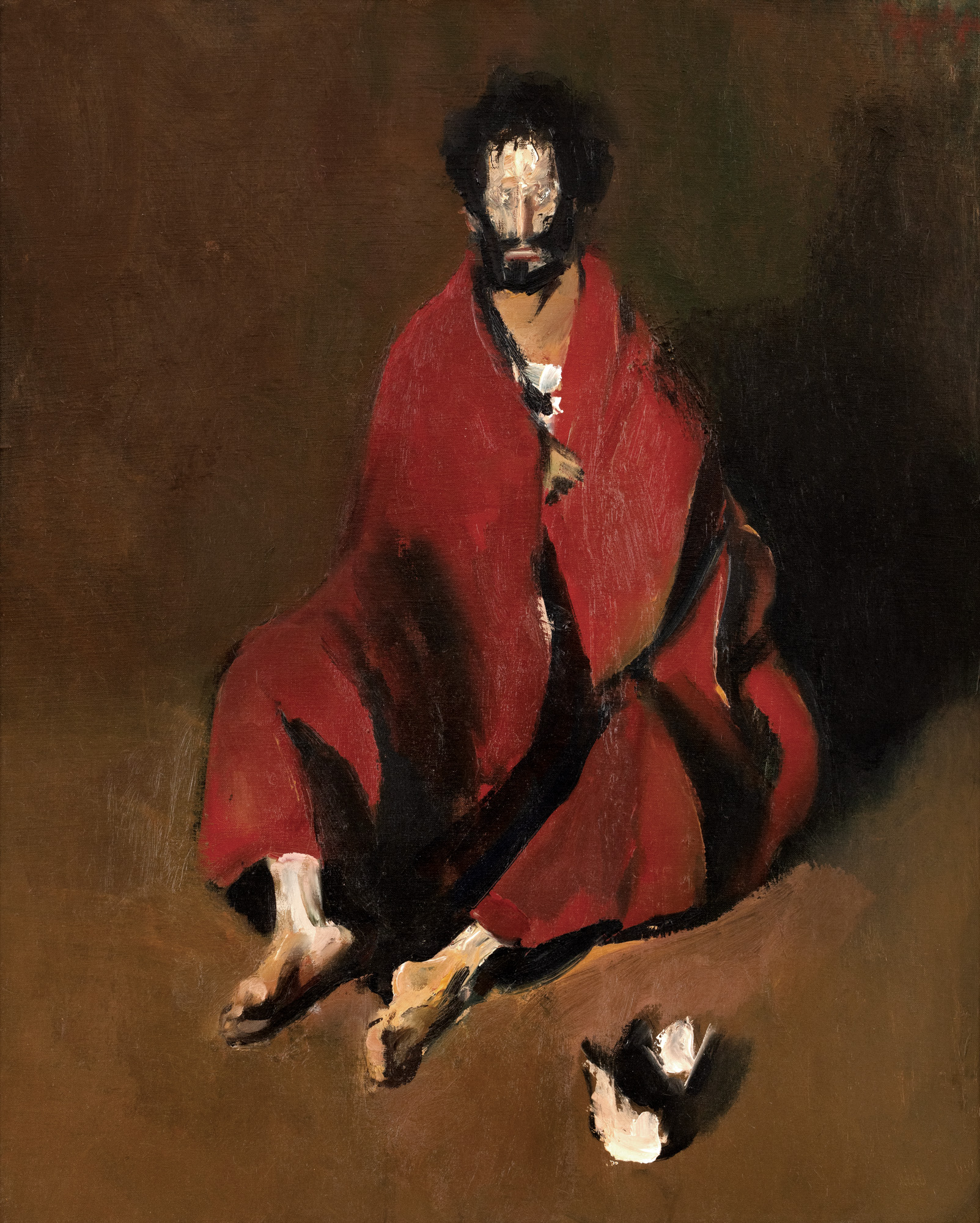
70. Mad King [anii '80]
-
Corneliu Baba
lot.estimate:
25.000,00 EUR
- 45.000,00 EUR
lot.sold:
39.000,00 EUR
- signature
- signed top right, in red, "Baba"
- medium
- oil on canvas glued on cardboard
- description
- The roots of manifestations in the genre of portraiture reveal themselves from an early age: in high school, Corneliu Baba was known as the "portraitist of the city." Most of the notable personalities of Caransebeș posed for him. Gradually, he makes self-portraits, portraits of loved ones or of reputable names such as: Tonitza, Enescu, Sadoveanu and Arghezi, or he stops on particular subjects: the mad king, peasants or the harlequin. The physiognomy, face and inner features of the characters stand out, at Baba, as a vehicle of human psychologies. The artist consecrates, symbolically, archetypes such as the harlequin or the mad king. For Corneliu Baba, the notion of realism takes on a much wider meaning and enjoys the artist's ability to use his imagination and the reserves of the psychic fund. The journals kept by the artist throughout his life represent a valuable treasure in which details regarding his life and work are carefully noted. Taciturn and solitary in the decades marked by cold and darkness, the master will concentrate his pen and brush on his artistic perfection. Named by Corneliu Baba as the "portrait without a biography", the mad king transcends beyond this title and develops throughout an entire cycle of dedicated works. The artist noted about the subject: "my mad king, in all the paintings, is nothing but the "poor man" sick, tortured by phantoms and the echo of the curses of those who had the chance to survive his acts of violence and sadism, from the pathetic hour of his horrible glory." The dramatic tension of the subject is therefore constituted from quasi-demonic impersonations and unspoken interior apologies. The crownless king becomes an allusion to all the horrors and atrocities that the artist, like so many millions of his contemporaries, had to passively witness. Corneliu Baba works consistently, adding reds and grays where he feels necessary. Visually, he starts from Goya's work, and auditory, on the background of his workshop and of the opera lies the music of Grieg - Peer Gynt. Scared, tortured, in monumental poses or illustrated drawn out, to the ground, with a gaze deprived of pupils, but with expressive grimaces; with hands extended towards an uncertain direction or propped in the ground; sitting directly on the floor, the king confined in the grip of his own prison appears obsessively in Corneliu Baba's work starting with the ‘70s. The improvised robe that covers his whole body, depicted either in low tones or in strong shades of bright red, the lost gaze and the bare soles; the paper crown or the lack of it (placement, in this case, near it) or the vagabond dog that accompanies him throughout several works reveal a dynamic composition, charged with interior tumult.
- bio
- The album "Corneliu Baba", Publishing House of the Romanian Cultural Institute, Bucharest, 2008. ȘUȘARĂ, Pavel, "Corneliu Baba", Official Monitor Publishing House, Bucharest, 2013.
- dimensions
-
- width: 44 cm
- height: 53.5 cm
- dating
- anii '80