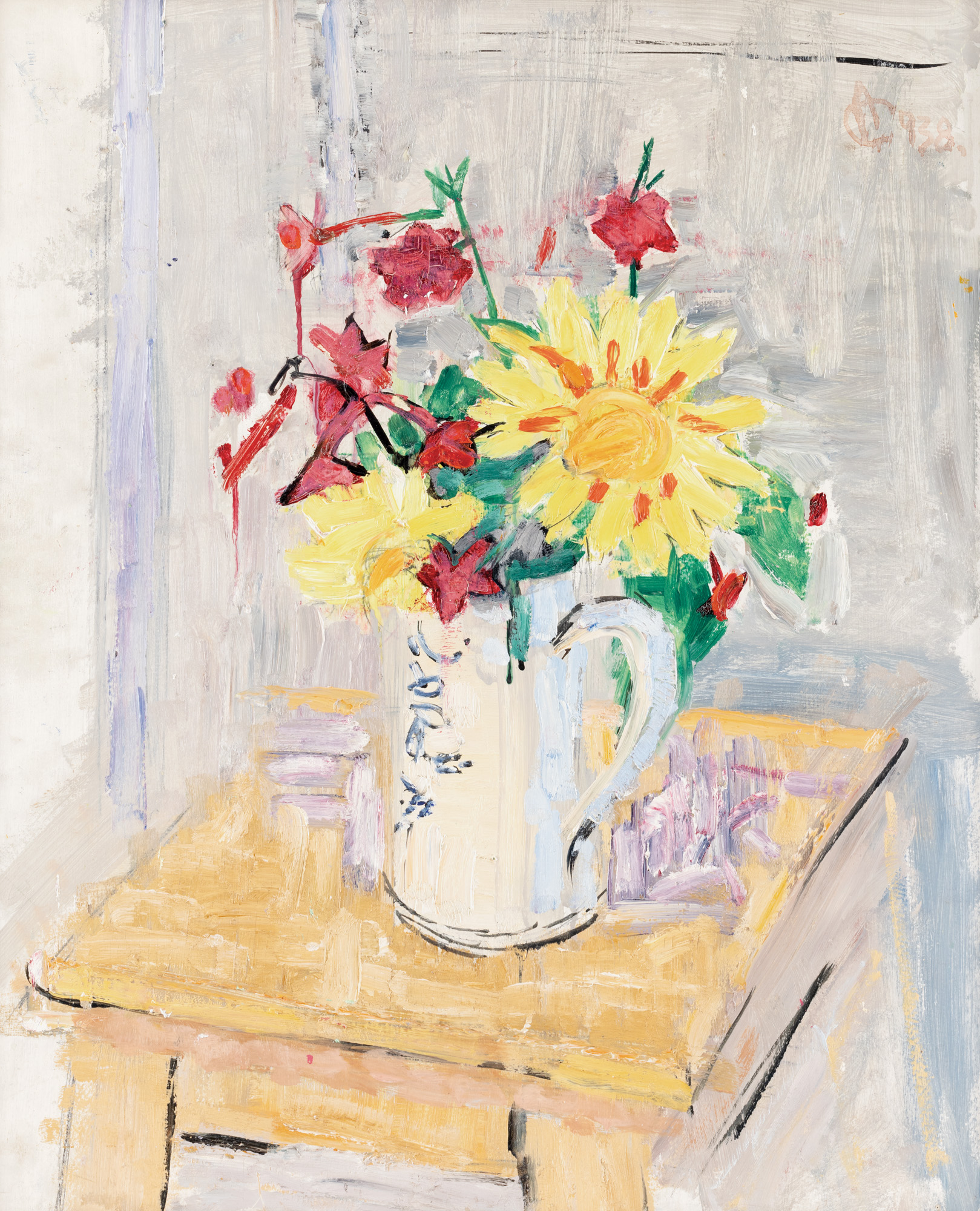
69. Sunflower [1938]
-
Alexandru Ciucurencu
lot.estimate:
7.000,00 EUR
- 12.000,00 EUR
lot.sold:
9.000,00 EUR
- signature
- signed and dated top right, with brown, "AC, (1)938"
- medium
- oil on cardboard
- description
- Ciucurencu will excel especially in the realization of still lifes. In this pictorial genre, the artist will remain known due to his preference for warm and intense tones, his skill of melodious organization of the composition and the ability to interpret in lyrical rhythms the chromatic adjacencies. Ciucurencu admires the flowers painted by his forerunners, especially those of Luchian. He finds inspiration in the artist's work, but his flowers remain anchored in a representation where the emphasis is mostly on the chromatic, while the form acquires secondary connotations. The present artwork is characteristic of the first period of his creation, lively in color and light effects. The obsession with color will never leave the artist, but he will direct his attention towards achieving a compositional harmony through the adjacency of light, nuances, and contrasts. As a successor to post-impressionism, he acquires some of the characteristics of this trend: the autonomy of color and the use of strong, vibrant hues, but does not shy away from introducing black into his works. His drawing skills are particularly revealed in the outlines through which the artist defines his represented subjects. Ciucurencu masterfully controls the pairing of lines and harmonization of colors. Often presented as a "colorist", the artist considers himself a successor of painters who also had a particular concern for color: Luchian, Ressu, Lhote or Pallady. He knows how to operate with the set of values he acquires under the guidance of André Lhote: he distributes light gradually, following the logic of reality and masterfully applies chromatic effects.
- bio
- IONESCU, Radu, "Ciucurencu", Semne Publishing House, Bucharest, 1994. OPRESCU, George, "Alexandru Ciucurencu", Meridiane Publishing House, Bucharest, 1962.
- dimensions
-
- width: 49 cm
- height: 60 cm
- dating
- 1938